Wi-Fi is for Coffee Shops: The Hidden Cost of Wireless-Only Offices
By Dylan Banks

The quick answer: A wireless-only office trades reliability and security for convenience — fine for a coffee shop, risky for an agency moving sensitive client data. A wired backbone with segmented, monitored Wi-Fi reflects the security-by-design approach CISA recommends for small businesses.
Coffee shops are for casual browsing.
They are for scrolling through social media or answering a quick email while waiting for a latte. They are built for convenience, not for mission-critical business operations.
Yet, many insurance agencies run their entire operation on a consumer-grade Wi-Fi network.
They rely on invisible signals to carry sensitive customer data, process policy changes, and host high-stakes VoIP calls. It’s convenient, sure. But it’s also a recipe for frustration, drops, and security gaps.
In a professional State Farm agency, Wi-Fi should be the supplement, not the backbone.
If your primary workstations aren’t plugged into a wall, you are leaving your agency’s productivity to chance. Here is why wireless-only offices are a hidden drain on your business and how a wired infrastructure changes the game.
The Latency Trap: Why Your VoIP is Dropping

Voice over IP (VoIP) is the lifeblood of an agency.
If your voice cuts out during a quoting session, you look unprofessional. If your video freezes during a client presentation, you lose momentum.
Wi-Fi is inherently "half-duplex." This means it can only send or receive data at any given moment, it can't do both simultaneously. This creates microscopic delays known as latency.
In a home environment, you don't notice it. In an office with five people on calls, three people scanning documents, and a dozen background apps syncing to the cloud, these delays stack up.
The result? Jitter. Lag. Dropped calls.
A wired Ethernet connection is "full-duplex." It sends and receives data at the same time without the "collision" issues of wireless airwaves. It is immediate. It is consistent. It is the only way to ensure your phone system works every single time.
Reliability and the "Invisible Walls"
Wi-Fi signals are fragile.
They are affected by the thickness of your office walls, the location of your microwave, and even the Bluetooth signals from your team's headphones.
When you run an office on Wi-Fi alone, you create "dead zones" and "weak spots." Your staff shouldn't have to move their laptop three inches to the left just to get a stable connection for a carrier portal.
A wired infrastructure removes the variables.
When you plug into a managed network from Agent Choice Internet, you get 100% of the speed you pay for, 100% of the time. No interference. No signal degradation. Just pure, raw performance delivered directly to your desk.
Security: Keeping PII Behind Physical Walls
Insurance agents handle Personally Identifiable Information (PII) every day.
Drivers' license numbers, social security numbers, and financial records are constantly moving through your network.
Wi-Fi signals don't stop at your office walls. They bleed into the parking lot. They reach the office next door. Even with passwords, a wireless network is an open invitation for "sniffing" and potential breaches.
A wired connection is physically secure. To access the data on a wired line, someone usually has to be inside your building, physically plugged into your hardware.
For an agency focused on compliance and protecting the client's interest, a wired backbone isn't just a technical choice, it’s a security standard.
UniFi Managed Wi-Fi: The Enterprise Supplement

Don't get us wrong: you still need Wi-Fi.
Your clients expect it in the waiting room. You need it for your tablet when you’re walking a customer through a policy on the couch. Your staff needs it for their mobile devices.
The difference is how you deploy it.
At Agent Choice Internet, we use commercial-grade UniFi hardware to provide a managed Wi-Fi experience. This isn't the "all-in-one" router you get from the cable company.
We install dedicated Access Points (APs) that are designed to handle 100+ devices without breaking a sweat. We segment your network so that guest Wi-Fi is completely isolated from your private agency data.
Wi-Fi becomes a high-speed convenience for mobile tasks, while the heavy lifting stays on the wires.
The Done-For-You Solution
Most agents don't want to think about "full-duplex" or "latency." You want your internet to work so you can sell insurance.
That is where we come in.
We handle the entire transition from corporate-managed internet to your own private, high-performance network.
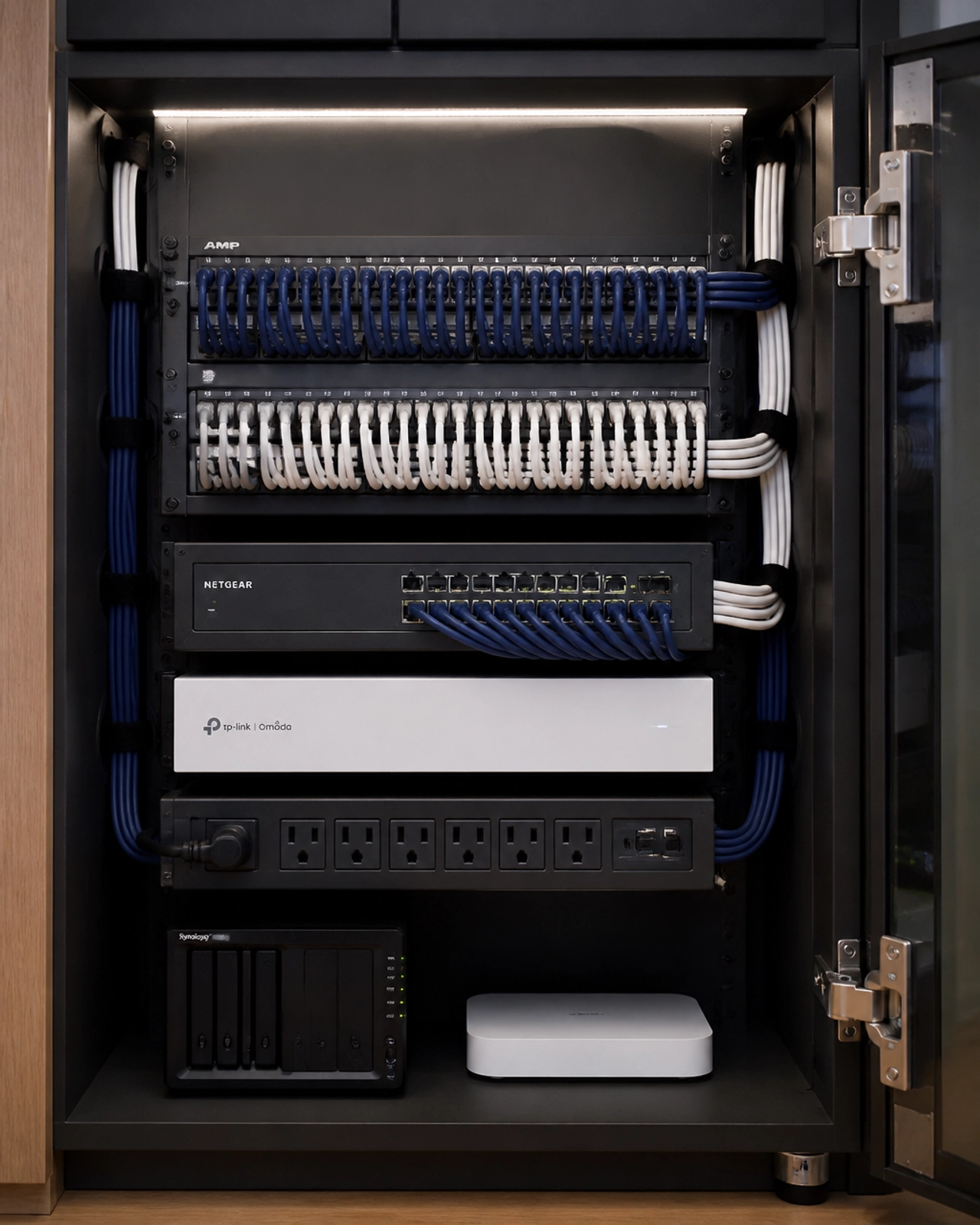
- We Handle the ISP: We find the best provider, negotiate the contract, and become their primary contact. If the internet goes down, you don't call the ISP. You call us.
- We Build the Wired Backbone: We oversee the installation of commercial-grade hardware that puts speed exactly where it's needed, at your desks.
- We Manage it Forever: Our service is a white-glove, monthly managed service. We monitor your network 24/7, push security updates, and replace hardware if it fails.
You get the reliability of a Fortune 500 network on a small business budget. Most agents find that between their State Farm stipend and our transparent pricing, they pay less than $20 a month out of pocket for a totally managed solution.
Ready to stop running your business like a coffee shop? Get started with Agent Choice Internet today.
Q&A: Wired vs. Wireless in the Insurance Office
1. Does a wired connection mean I have to have messy cables everywhere?
Absolutely not. A professional installation hides the cabling inside walls or uses discrete management systems. When we design your office, the only thing you’ll see is a single, clean cable connecting to your computer or VoIP phone.
2. Can I still use my laptop's Wi-Fi if I'm plugged in?
Yes, but your computer will prioritize the wired connection because it is faster and more stable. You get the best of both worlds: the freedom to move and the power to perform.
3. I already have internet service. Can you still help?
Yes. Even if you have a contract with an ISP, we can step in to manage that relationship and replace your consumer-grade router with our managed hardware. We turn your basic connection into a professional enterprise network.
4. Is the equipment expensive to buy?
You don't buy the equipment. We lease it to you as part of our managed service. This means no large upfront costs and no "surprise" expenses when a router dies three years from now. We replace and upgrade it as part of your monthly fee.
5. Why can't I just use the router the ISP gave me?
ISP routers are built for the "average" home user. They aren't designed to handle the security requirements of an insurance agency or the high-volume traffic of a busy office. They are "unmanaged," meaning if there’s a problem, you’re on your own. We provide "managed" hardware that we control and fix remotely.
What do agents usually ask about wireless-only office setups?
Does my agency really need wired connections if I already have fast Wi-Fi?
Yes. Wi-Fi is half-duplex—it can only send or receive data at any given moment, not both simultaneously. For VoIP phones and carrier portal uploads running at the same time, wired Ethernet is the only way to guarantee consistent, jitter-free performance.
What is VLAN segmentation and why does my agency need it?
A VLAN (Virtual Local Area Network) creates isolated digital lanes inside your office. Your client-facing guest Wi-Fi sits completely separate from your internal agency network, so a visitor’s device cannot see your workstations, printers, or sensitive policy data.
Can a better consumer mesh router fix my office Wi-Fi problems?
Better consumer hardware helps at the margins, but it does not solve the underlying issues—no true VLAN segmentation, no remote monitoring, and a performance ceiling that breaks down under sustained business load. Commercial UniFi hardware is a different class of product built for continuous, high-traffic environments.
What happens when my internet connection goes down?
We monitor your network 24/7 and receive an automated alert the moment a circuit drops. We also recommend a 5G failover line that switches automatically, so your phones stay live while we work the ISP issue on your behalf.
How long does the installation process take?
Most agency installations are completed in a single visit. We handle ISP scheduling, hardware installation, network segmentation, and final testing. You do not need to be involved in any of the technical steps.
Related reading: Consumer Routers vs. UniFi Managed Wi-Fi: Which Is Better For Your Agency? and Wired is King: Why ‘Good Enough’ Wi-Fi is Killing Your Agency’s Productivity.